
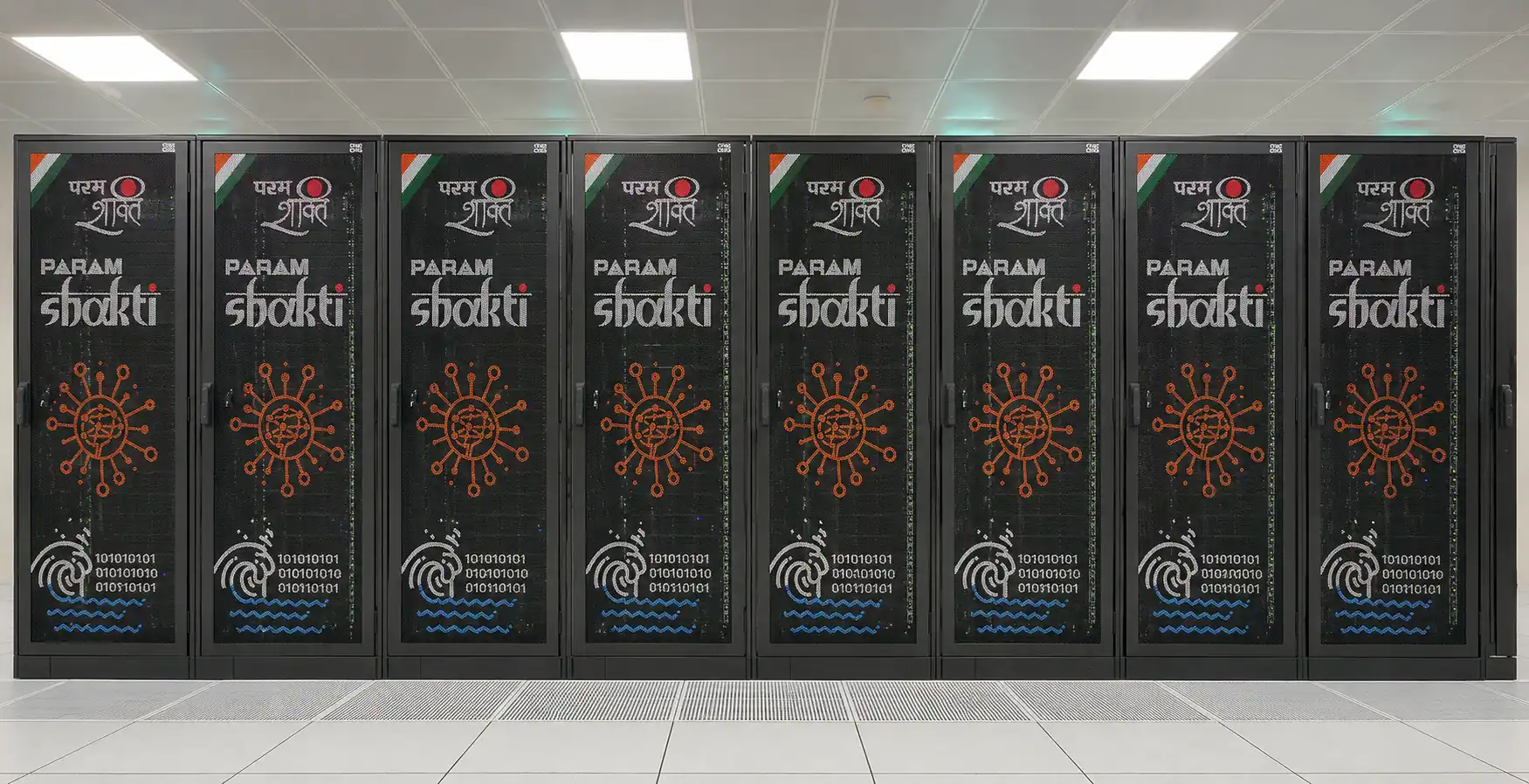

PARAM Shakti
A state-of-the-art high-performance computing system based on a heterogeneous and hybrid architecture, combining Intel Xeon Skylake processors with NVIDIA Tesla V100 GPUs for computational efficiency across scientific applications.
Overview
PARAM Shakti is a heterogeneous, hybrid supercomputer based on Intel Xeon Skylake processors and NVIDIA Tesla V100 GPUs, designed and implemented by the HPC Technologies team at the Centre for Development of Advanced Computing (C-DAC). It comprises 2 master nodes, 8 login nodes, 10 service/management nodes, and 442 CPU+GPU compute nodes, with a total peak computing capacity of 1.66 PFLOPS.
Its compute nodes are connected via a Mellanox (EDR) InfiniBand interconnect network, and the system uses the Lustre parallel file system for high-throughput storage.
Node Configuration
Master Nodes
Master Nodes supervise and coordinate the cluster. They manage hardware health, workloads, and track utilization across all components.
- 2 × Intel Xeon SKL G-6148
- Cores = 40, 2.4 GHz
- Total Cores = 80 cores
- Memory = 384 GB
- Total Memory = 768 GB
- HDD = 900 GB
Login Nodes
Login Nodes act as user entry points. They support tasks like file transfers, editing scripts, and job submissions, with time and memory limits.
- 2 × Intel Xeon SKL G-6148
- Cores = 40, 2.4 GHz
- Total Cores = 320 cores
- Memory = 384 GB
- Total Memory = 3,072 GB
- HDD = 900 GB
Service Nodes
Service Nodes handle job scheduling and cluster services. They maintain reliability and ensure smooth day-to-day operation of PARAM Shakti.
- 2 × Intel Xeon SKL G-6148
- Cores = 40, 2.4 GHz
- Total Cores = 240 cores
- Memory = 384 GB
- Total Memory = 2,304 GB
- HDD = 900 GB
CPU Compute Nodes
CPU Compute Nodes are the workhorses of PARAM Shakti. They execute both interactive and batch jobs with local SSDs for fast scratch storage.
- 2 × Intel Xeon SKL G-6148
- Cores = 40, 2.4 GHz
- Total Cores = 15,360 cores
- Memory = 192 GB
- Total Memory = 73,728 GB
- SSD = 480 GB
High Memory Nodes
High Memory Nodes provide extended RAM per node, enabling simulations and jobs with very large memory requirements beyond standard compute nodes.
- 2 × Intel Xeon SKL G-6148
- Cores = 40, 2.4 GHz
- Total Cores = 1,440 cores
- Memory = 768 GB
- Total Memory = 27,648 GB
- SSD = 480 GB
GPU Compute Nodes
GPU Compute Nodes combine CPUs with NVIDIA V100 GPUs. CUDA and OpenCL optimized applications achieve huge speedups for AI and HPC workloads.
- 2 × Intel Xeon SKL G-6148
- Cores = 40, 2.4 GHz
- Total Cores = 880 cores
- Memory = 192 GB
- Total Memory = 4,224 GB
- 2 × NVIDIA V100 (16 GB each)
Storage
PARAM Shakti uses the Lustre parallel file system. It offers scalable and reliable storage with high throughput, ideal for large scientific workloads.
- Primary Storage = 2.1 PiB
- Archival Storage = 500 TiB
- Throughput = 50 GB/s
Operating System
The cluster runs on Linux (CentOS 7.6), a stable operating system widely used in HPC. It provides compatibility and reliable performance for users.
- OS = Linux
- Distribution = CentOS 7.6
Network
NSM/HPC users reach the cluster through a firewall into the login/compute tier, which fans out across four dedicated networks — Secondary (1G), 10G, IPMI, and Infiniband — to the switch tier, and onward to the service, master, and storage nodes.
Param-Seva
| HPC Programming Tools | Performance Monitoring | HPCC | IMB/OSU | IOR | HPCG | C-DAC Tools IDE CAPC | ||||||||||||||||
| Visualization Tools | Ferret | GrADS | ParaView | VisIt/ VMD | ||||||||||||||||||
| Application Libraries | NetCDF/ HDF/ etc. | Math Libraries | Python Libraries | GNU Scientific Library | CHReME | |||||||||||||||||
| Development Tools | Intel Cluster Studio | GNU | CUDA Toolkit/ OpenACC | |||||||||||||||||||
| Communication Libraries | Intel MPI | MVAPICH2 | Open MPI | PGAS | C-Chakshu | |||||||||||||||||
| Middleware Applications and Management | Cluster Monitoring/ Help Desk | Ganglia | C-DAC Tools | Nagios | XDMoD | osTicket | ||||||||||||||||
| Resource Management/ Scheduling/ Accounting | SLURM | SLURM Accounting | HPC Tasks Automation Scripts | |||||||||||||||||||
| Provisioning | OpenHPC (xCAT) | |||||||||||||||||||||
| File System | NFS | Local FS (XFS) | Lustre | GPFS | ||||||||||||||||||
| Operating Systems | Drivers | OFED | CUDA | Network & Storage Drivers | Cluster Checker Scripts | |||||||||||||||||
| Operating System | Linux (CentOS 7.x) | |||||||||||||||||||||